Free · numbers computed server-side
Show your account’s activity on your website
Show orders, bookings, appointments and average ratings in small notices. Cenaly.ru calculates the figures; you do not enter your own numbers or notification text.
The widget is free. It needs recent events in Cenaly.ru; notices stay hidden when there is too little data or a threshold is not met.
- Figures from account orders, bookings and ratings
- No guest names or review text in notices
- Configure thresholds, pauses and display limits

What the guest sees — and what appears on your side
Guest screen

In your dashboard
Where the data goes The site receives public numeric aggregates without names or review text. The widget also sends load, display and dismissal events for statistics.
- fact types: orders, table bookings, appointments and average rating
- 4
- maximum data age — beyond that nothing is displayed at all
- 36 h
- days of rating history, and never fewer than 5 ratings inside it
- 90
- for the widget: it is part of the platform, not a notification service
- $0
How it works for the visitor
- 1
A visitor opens the page
They start looking at your offer. The badge doesn’t jump out at once: you set the delay before the first one, and by default the widget lets people settle in.
- 2
They notice a real number
Examples: “14 orders today” or “★ 4.8 — 37 ratings”. Your site shows eligible account data, not these demonstration figures.
- 3
They carry on reading
The badge leaves by itself, and the next one appears no sooner than the pause you set — 45 seconds by default, counted from the moment the previous one left, so nothing flickers.
- 4
They dismiss it if they’d rather not
The cross switches the badges off for the rest of the visit. If they just move to another tab, impressions wait for them instead of being spent.
Set up in three steps
Create an account and add your site
Signup opens setup for the selected product. Have your domain and permission to insert code ready.
Configure and install
Follow your platform instructions. Blocking trackers before consent requires the early CMP script, not just the shared async tag.
Test your published site
Enable the widget and try the visitor action on the published page. Settings may appear after the cache refreshes.
The tag
<script src="https://cdn.cenaly.ru/site/v1.js" data-domain="your-site.com" async></script>Shared widget tag. See the separate CMP instructions for blocking trackers before consent.
What the social proof widget does
Count what actually happened
Figures come from events in your Cenaly.ru account: placed orders, created bookings and appointments, and received ratings. Installing the tag on another shop does not import its orders. Counts represent placed orders or created bookings and appointments, not paid purchases, completed visits or revenue.
Use account data instead of manual text
Settings have no field for a custom count or notification text. Wording follows the event type and count; public notices show no guest names, review text or purchased items.
Retire stale data automatically
Anything older than 36 hours is not displayed in any form, and “today” is checked against the venue’s own calendar: once the day turns over, yesterday’s orders stop counting as today’s. Best for venues with days off and uneven flow.
Keep a decency threshold
A number below the threshold isn’t shown at all — 3 by default. The average rating has a floor of its own: it only appears from 5 ratings over 90 days, and that floor cannot be lowered. Best for new locations and seasonal businesses with sparse data.
Don’t get in the visitor’s way
Up to 4 badges per visit by default, the pause counted from the moment the previous one left, a hidden tab spends no impressions, the cross switches the badges off for the session, and the animation respects the system “reduce motion” setting. Best for sites with long sessions.
Put it where it belongs
Any of the four corners, your own accent colour, page masks, device and a schedule. If one of our floating buttons already sits at the bottom, the badge rises above it instead of landing on top. Best for sites running several widgets.
Where it pays off
A storefront with delivery
Example: “14 orders today” on the menu page shows the visitor that people have already ordered through the site today.
A salon with online appointments
Example: “7 appointments this week” on a service page shows real demand without a single invented review.
A restaurant taking bookings
Example: “The table was booked 5 times today” belongs exactly where a guest is choosing between you and the place next door.
An average rating on the page
Example: “★ 4.8 — 37 ratings” comes from your own reviews over 90 days and appears only from 5 ratings.
Campaign landing pages
Masks keep the badges on the landing pages you choose, and away from the blog and the legal sections.
A new location with no history
While the numbers are small the widget stays silent: the decency threshold won’t advertise an empty room, and the badges appear by themselves once the flow starts.
What it looks like in the product
Settings
View full size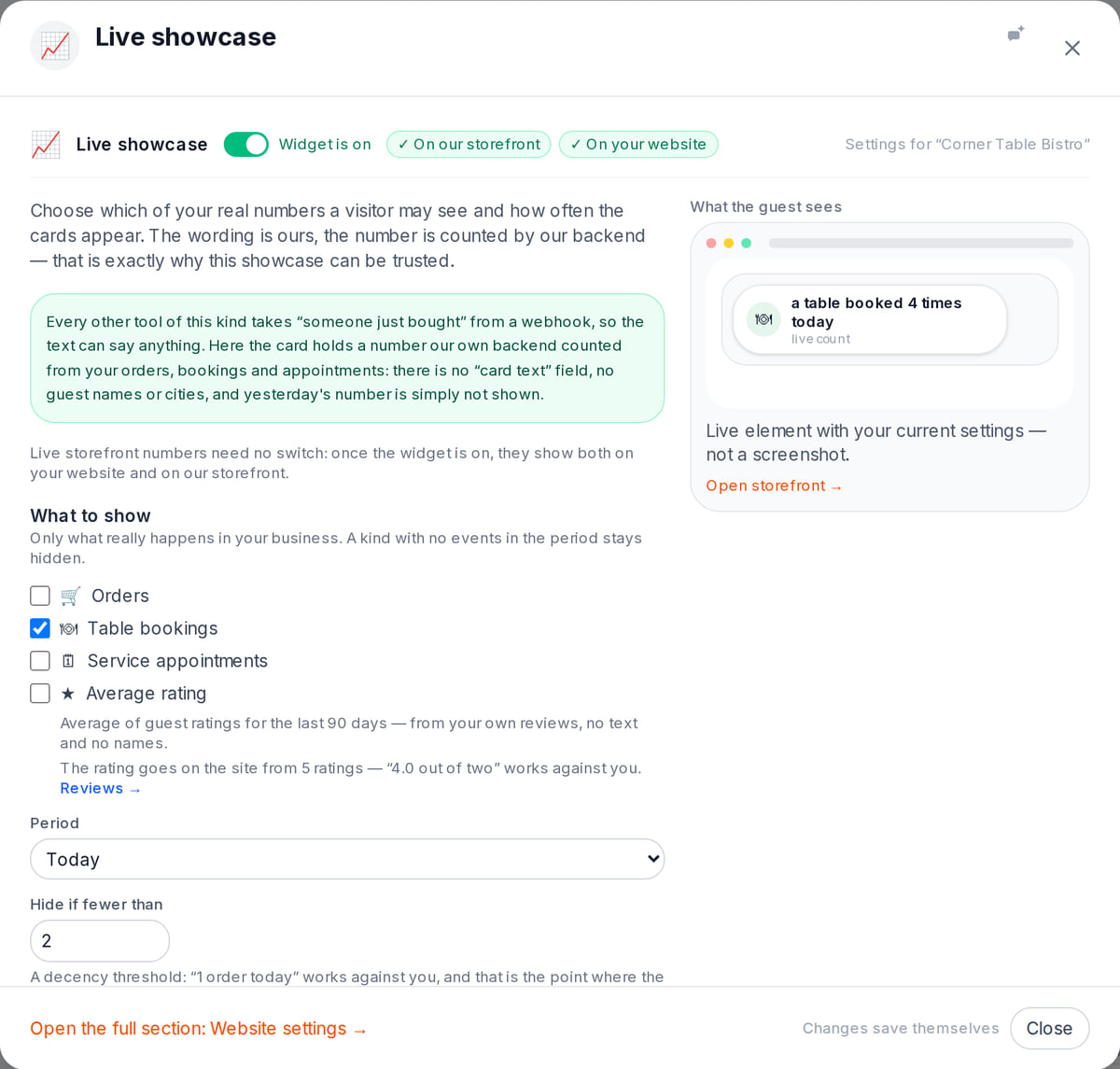
The owner picks event kinds and the threshold

How it works in practice
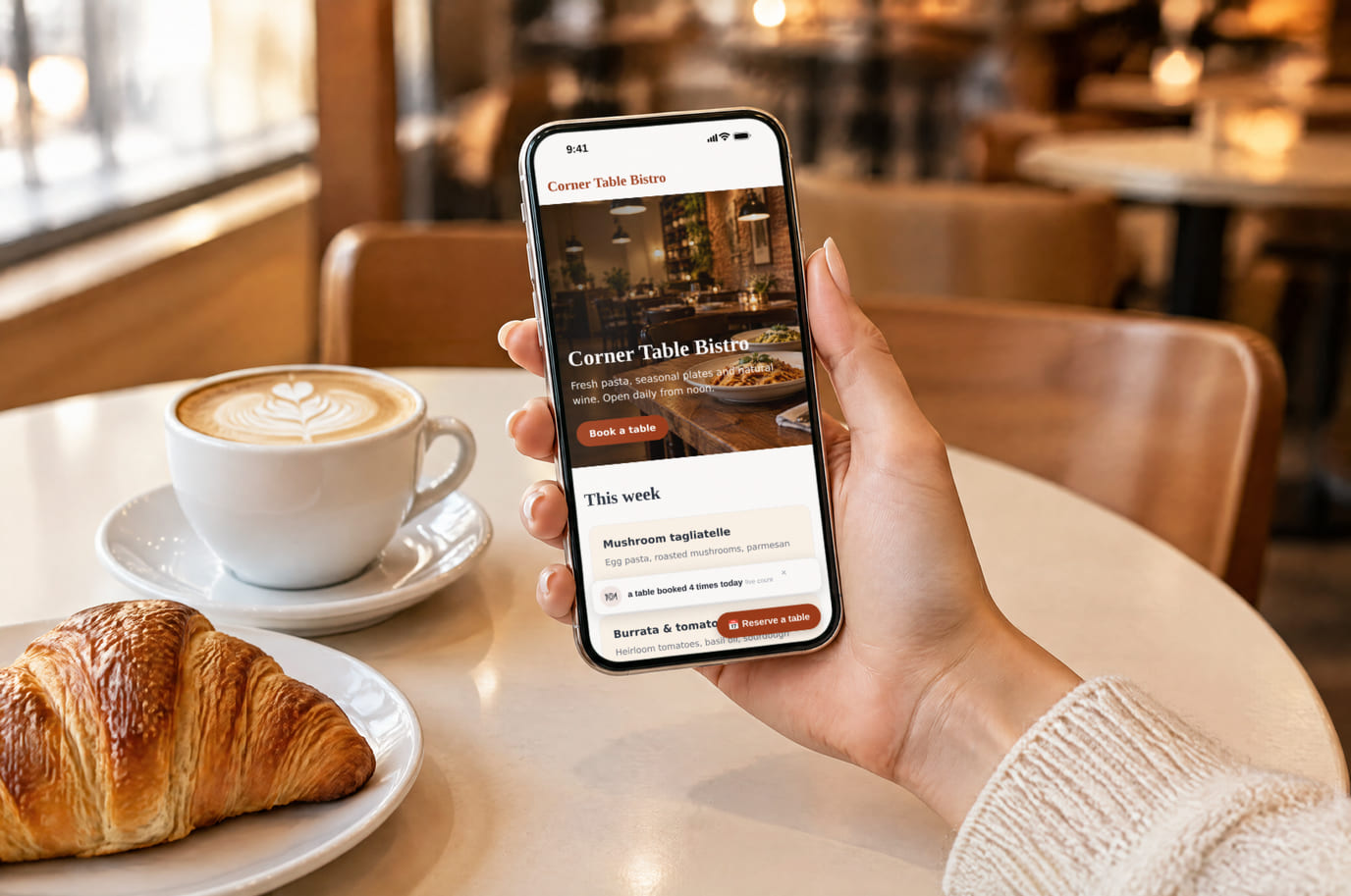
Illustration. A live number is a reason to book now

How it looks on your site
Example interface. Customise colours, position and labels, then check your page on desktop and mobile.

Where it goes
Exact menu names and plan requirements, taken from each platform’s own help center.
Sites built with our website builder ship with the widgets already wired — nothing to paste.
Step-by-step guides per platform — in the help center →Pricing
Free
- No separate charge for the widget or impressions
- Data thresholds and configured frequency limits still apply
- Install the tag on your site; the same toggle also enables notices on the Cenaly.ru storefront
- Figures come from events in your Cenaly.ru account: placed orders, created bookings and appointments, and received ratings. Installing the tag on another shop does not import its orders.
What is included and what costs extra
Basic versions of 9 of the 13 widgets are free. Table booking, popups, help and legal pages on external sites are extensions. Connected services can cost extra.
With and without
| Without the widget | With the widget | |
|---|---|---|
| Where the number comes from | ✕ Account activity is not visible to site visitors | ✓ Our server counts the number as the order, booking, appointment or review lands |
| Badge text | ✕ Figures must be copied into page text manually | ✓ There is no “badge text” field: the system builds the wording from type and number |
| Stale data | ✕ Published figures need manual freshness checks | ✓ Anything older than 36 hours is hidden, and “today” follows the venue’s calendar |
| Personal data | ✕ Your publication method determines which details are public | ✓ The public schema has no fields for a name, a city or one person’s purchase |
| Cost | ✕ You need a way to display account activity | ✓ The widget is free and works on your site and on the storefront at once |
Honest about the limits
- The widget only shows facts that qualify: with no fresh data past the thresholds there will be no badges at all, and that is not a fault.
- An order rung up at the till straight into a closed status doesn’t reach the badges: they describe the website’s guest flow, not the shift’s takings.
- The average rating is published from 5 ratings over 90 days. You can raise your own threshold, but not lower it.
- You cannot enter custom notice text or counts. This is an editor restriction, not verification of every purchase; see the counter definitions above.
- The badge text is translated into four languages (en, ru, ka, tr) — in other site languages it shows in English.
- The widget does not count free appointment slots: live availability is the job of the appointment widget, not of social proof.
- Figures come from events in your Cenaly.ru account: placed orders, created bookings and appointments, and received ratings. Installing the tag on another shop does not import its orders.
- Counts represent placed orders or created bookings and appointments, not paid purchases, completed visits or revenue.
Who it's for
- Venues taking online orders and table bookings
- Salons and studios running appointments through Cenaly.ru
- Anyone whose demand is real but invisible on the website
What social proof is and how to show it without inventing anything
Social proof on a website is a short note that other people have already made a choice: how many orders today, how many bookings this week, what the average rating is. It works on a simple basis — people feel safer where others have been before them.
The trouble is that the genre damaged itself. More often than not the badge is arbitrary text that arrived from outside, and in places the events are typed in by hand. Visitors sense it, and a line like “someone from the next town just bought this” produces distrust rather than trust — and it rubs off on your offer.
This widget is built differently at the schema level: our server counts the number as an order, booking, appointment or review lands, and the public file has no free-text field at all — there is physically nowhere to put a name or an invented purchase, and a build test checks it. Stale data retires itself: anything older than 36 hours is hidden, “today” is checked against the venue’s calendar, and the average rating is only published from 5 ratings over 90 days. The owner chooses WHAT to show and from which threshold — not what it will say.
Social proof is the wrong widget for a young site with no orders and no ratings yet: the thresholds are built so that with empty data the badge simply never appears, which is better than invented activity. And it is not a popup — proof can say nothing beyond a counted number. If you need to carry an offer, a discount or capture a contact, that is the job of smart popups.
Questions and answers
What if there are no orders today?
There will be no orders badge until the number reaches the decency threshold — 3 by default. Other enabled fact types can still show if they pass their own conditions. If nothing qualifies, the widget stays silent, and that is deliberate: advertising an empty room does more harm than showing nothing.
Does it show customer names?
Settings have no field for a custom count or notification text. Wording follows the event type and count; public notices show no guest names, review text or purchased items.
Can I write my own badge text?
Figures come from events in your Cenaly.ru account: placed orders, created bookings and appointments, and received ratings. Installing the tag on another shop does not import its orders. Counts represent placed orders or created bookings and appointments, not paid purchases, completed visits or revenue.
Where do the numbers come from?
From your own events: an order reaching the “placed” status, a table booking or a service appointment being created, a review being applied. The recalculation happens as the event lands, not on a schedule.
How often does a visitor see the badges?
Up to 4 per visit by default, each staying for a few seconds, with the pause counted from the moment the previous one left (45 seconds by default). The cross switches the badges off for the session, and a hidden tab spends no impressions.
What does the average rating show?
The average and the number of ratings over 90 days from your own reviews — three numbers and nothing more. It is published from 5 ratings; review texts, names and dates are not in the public file.
Does it also run on my Cenaly.ru storefront?
Yes. One toggle switches the widget on for both your website and your Cenaly.ru storefront: the same selection rules, the same timings, the same text. There is deliberately no surface switch — you cannot enable the badges on only one of them.
How do I add it, and what does it cost?
The widget reads a public aggregate and selects eligible facts to display. The loader, data file and interface use network and device resources. Test speed and positioning on your page, especially beside other widgets.
Will social proof slow my site down?
Social proof is the lightest of our page widgets: about 15 KB gzipped, with the async attribute and after the page has loaded. It doesn't compute anything in the browser — our server refreshes a ready public file the moment an order, booking or review happens, and the widget reads it once. No database calls, no work on the visitor's device. The badge lives in a Shadow DOM.
What data does the widget send?
The site receives public numeric aggregates without names or review text. The widget also sends load, display and dismissal events for statistics.
What do I need to install it?
An account, your website domain and permission to insert code. Prepare the selected widget’s data and test your published page. Follow the separate cookie banner instructions for early tracker blocking.
Will it work on my page?
Style isolation reduces conflicts but does not replace testing. Check buttons, forms, mobile layout and other scripts on your site.
What about languages and data?
Set your own texts separately; built-in labels fall back to English where translations are missing. Core data is stored in the brand’s cloud. Connected AI, telephony and other services have separate processing terms.
More — installation per platform, settings and troubleshooting — in the help center. Installation guide →
Works together with
All 13 widgets →Popups and forms
Modals, slide-ins, bars, embedded forms, coupons and quizzes with display rules and A/B testing
Add-on, price in the catalogue
Video bubble
A bubble with a clip from your menu in the corner of your site: tap for video with sound and an “Order” button
Free
Ordering on your site
An order button opens your storefront over your existing site
Free
Set up your account’s activity display
Signup opens activity-notice setup. Choose fact types, a threshold and display pages, then check the published site.
Set up activity noticesThe widget is free. It needs recent events in Cenaly.ru; notices stay hidden when there is too little data or a threshold is not met.